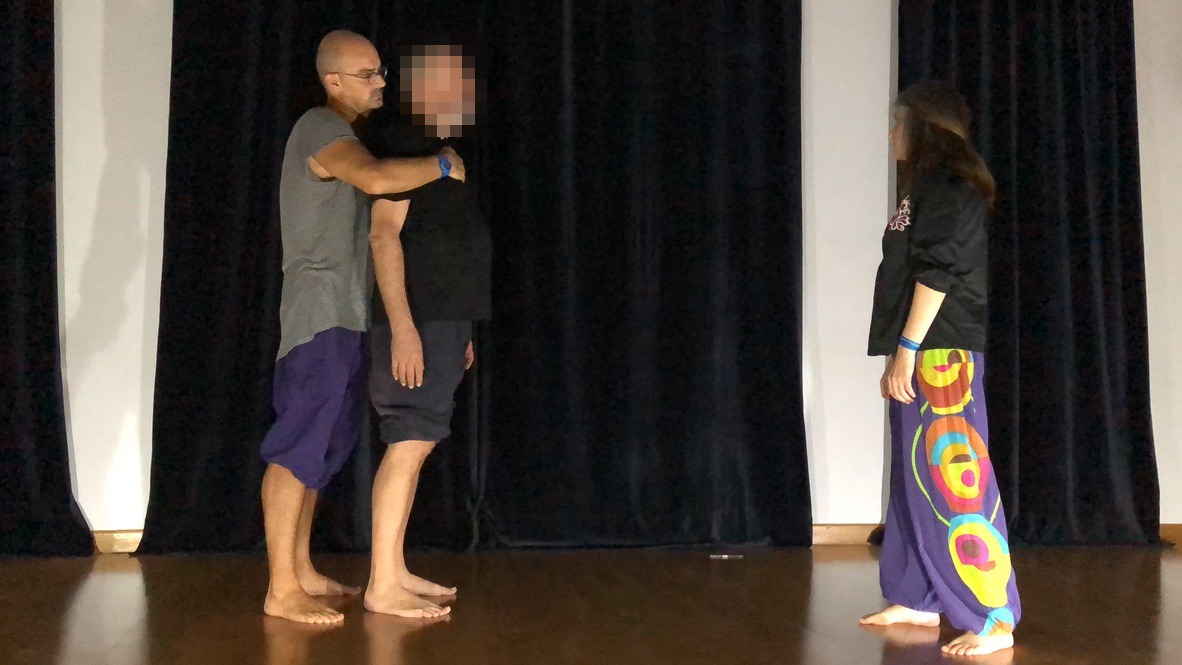
The only thing I asked of Eduardo was that he not speak.
That he start the scene again from the beginning, stand in front of his partner, and this time say not a single word. Just look.
He lasted four or five seconds. Then he started to move. Weight from one foot to the other, hand to the back of the neck, a glance at the ceiling as if there were something interesting up there. And then he stopped dead and his face went. Eyes wide open and nothing behind them. That blankness anyone who has facilitated a group recognises immediately.
Nobody in the room was breathing. Me neither, and I was on the other side of it.
What shows up there is always the same. The urge to say something. Anything. A take your time, it's fine that sounds like care and that deep down means the one who can't bear the silence is me.
Rescuing is dead easy
In conventional theatre, an actor who blocks is a problem. It breaks the show and you have to get them out of there however you can. Feed them the line, shift the focus, send someone else on stage.
We're not after the scene going well. We're after what happens to the person while they do it. So a jam that anywhere else would need solving is, here, exactly what's worth looking at.
If you rush in to fix it, you lose what was appearing. And there's something worse, which took me a long time to understand. Without meaning to, you tell that person their block was in the way. That what had just happened to them wasn't welcome right now, that it was interrupting the rhythm of the session.
I've rescued a great deal. The first few years, almost always. And over time I've had to admit that the well-meaning impulse to lend a hand had little to do with whoever was blocked and quite a lot to do with me, with my own need for things to move along.
Twenty seconds go a long way
The first thing is to do nothing, which is also one of the hardest things I ask of the people who train with me. Stay. Let the block exist for a while without rushing to clear it away.
And from there you can look calmly.
A question I use a lot. What's happening right now? Not so the person explains it — I don't want an analysis, least of all at that moment — but so they notice what's there. If the answer is I've gone blank, good, now we have somewhere to start. And what is that blankness like? Is anything happening while you're in there, any image, any sensation? When you get a little closer, it usually turns out it wasn't so empty after all.
The other way in is the body. Where do you feel it? Sometimes putting a name to a physical sensation lets you reach something the head couldn't get to. In my throat, like a knot. So we stay with that knot, and from there we carry on.
And there's one question I try never to skip. Do you want to keep exploring or would you rather stop? When someone feels they have no control at all, getting back the possibility of choosing changes things quite a lot. It sounds odd and it works. Knowing they can stop is usually what allows them to continue.
«I don't know how to be without talking»
Back to Eduardo, still standing there saying nothing.
He was in his forties, worked in an office, and was the soul of the group. One of those who make people laugh before things start, who fill any silence with a story. We'd been working together for weeks and one day I realised we knew rather little about him.
That afternoon we were improvising on goodbyes. He got the father saying goodbye to his son before a long trip. The scene called for staying, looking, holding. And Eduardo would start well, move closer, look at his partner… and then suddenly, this reminds me of the time I went to Argentina and…. He'd leave. He'd climb inside an anecdote and disappear. He did it three times.
That's why I asked him for the silent version. And it was brutal for him, far more than I expected.
I could have stepped in at any of those twenty seconds. He probably would have thanked me for it. I said the only thing that was needed.
Stay. Just stay.
And he stayed. He really looked at his partner and his eyes filled with tears. He didn't weep dramatically, nothing spectacular happened. Just full eyes and a very still man.
What he said afterwards has come back to me many times since. I don't know how to be without talking. If I go quiet, if I stay, then I feel. And I don't want to feel.
His blankness didn't come from forgetting what to do in the scene. He had reached a point where the usual — the humour, the anecdote, the inexhaustible warmth we all knew — was no longer any use for getting away.
There was no need to decide right then what any of it meant. It was enough that, when Eduardo couldn't speak, something appeared that weeks of workshop hadn't shown us.
That was the work of that afternoon. The goodbye scene never got played through, and it didn't need to be.
The other block, yours
So far I've talked about the participant. The other block gets talked about less, and it's the facilitator's.
The moment when someone stops dead in front of you, the whole group is looking at you waiting for you to do something, and you have no idea what to do. Your mouth goes dry. And on top of that you start thinking it must be showing.
It's what people write to me about most when they're considering the training. I'm afraid of not knowing what to do if something big comes up. And my answer is a bit of a disappointment, because there's no trick. There are plenty of times when I don't know what to do either.
What you learn over two years isn't a collection of brilliant interventions so you always have the answer to hand. You learn not to rush, to hold out a few seconds longer, and above all to tell the difference between intervening because the person needs it and intervening because the one who needs to stop feeling uncomfortable is you.
And that isn't learned much from reading. It's learned inside a group, watching others do it, with someone beside you the first few times your pulse quickens. And also, inevitably, by going blank yourself in front of everyone at some point and finding out that nothing bad happens.
In October the second cohort of the Theatre Gestalt training begins in Murcia. At some point during the first module somebody is going to go blank in front of everyone. I don't know who it will be, or what will show up for them, or what to do with it straight away.
What I won't do is rush to fill it. That much I have learned, and it took me a good few years.
Interested in the Theatre Gestalt training? The second cohort starts on 14–15 November 2026 in Murcia. I announce each new article on Instagram. If you'd like to write to me, there's the contact section.