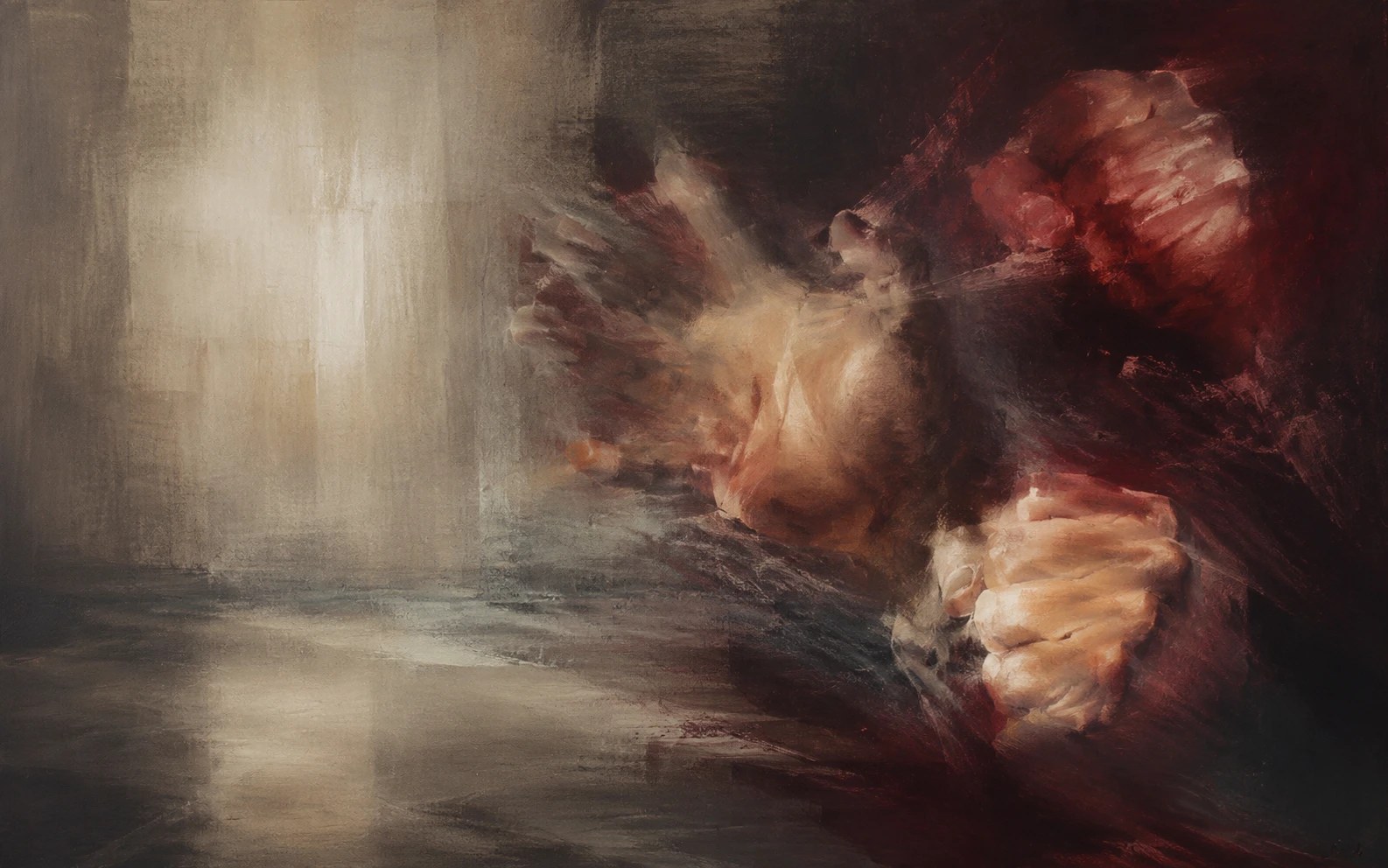
A pair improvisation, at an intensive on the Murcia coast. The instruction was simple. Start without speaking, and decide nothing before you begin.
She went still. Not the stillness of someone who hesitates for a second and then starts. Completely still. Shoulders, face, feet, her breathing high and short. Her partner carried the scene for a while and then stopped too, because there was nothing to lean on.
And in all that paralysis there was one single thing moving. Her hands, opening and closing into fists. Both of them, at the same time, over and over, with a very mechanical rhythm. As if it were running on its own and had nothing to do with the motionless woman it belonged to.
What I did instead of asking
I didn't ask her what was going on. If I ask, she has to manufacture an answer for me, and she'll manufacture it with her head — the part of her that knew least about what was happening. Besides, when someone is frozen in front of a group, a direct question usually adds another layer of paralysis. Now you have to answer, and you have to be all right, and in front of everyone.
I took a cushion, stood in front of her and held it at chest height.
Push. Put pressure on it. And notice what happens while you push.
She pushed weakly, with that politeness we all have at first. I asked for more. And at some point something changed in her feet. She planted them, found the floor and started pushing with her whole body.
There was no catharsis. She stopped, stood there, calm, and she was shaking.
There's a part of this I can't know, and I'd rather say so. I don't know how much of what came out was already waiting to come out, and how much appeared because I proposed pushing and following the movement. I gave it a direction. That part was mine.
It wasn't fear
I asked her about the shaking, assuming it was fear — which is what we assume almost every time.
She corrected me. It wasn't fear. It was energy running through her body, and she associated it with feeling powerful, with having strength available.
She was right, and I was about to put a label on her experience that didn't belong to it. This happens more than it seems. We see someone shaking and we've already decided inside what's going on with them, and then we work on our own decision instead of on what's theirs.
I asked her to breathe that. Not to explain it, not to understand it yet, just to stay there a while and let it move through her body. And afterwards, when she was ready, to look at the group and go from face to face.
Nobody applauded. Nobody rushed to hug her so it would close before its time. They looked at her, which is considerably harder.
«What if I intervene and get it wrong?»
It's one of the questions I'm asked most before people join the training, and I think it's a good question. The short answer is yes, you will get it wrong.
I always give notice on the first day of a workshop. At some point I'm going to risk something from the gut. It might open something interesting or nothing might happen, and if nothing happens that's fine too. I say it beforehand so that nobody has to trust blindly.
With the participant of the hands it went well. Although, as I've said, I don't know how much of it was waiting to come out and how much appeared because I proposed exactly that. I gave it a direction. There's no avoiding it, and it's best not to sell it as a revelation of the body.
That's what you train over two years. Not to always get it right. To hold what you open, to recognise when you've gone too far, and to know when something exceeds the room and you have to stop.
The second cohort starts in October, in Murcia. If you want to know how it works from the inside, write to me and we'll talk.
Interested in the Theatre Gestalt training? The second cohort starts on 14–15 November 2026 in Murcia. I announce each new article on Instagram. If you'd like to write to me, there's the contact section.